
Succession Planning
Lending and Protection Solutions For Inheritance Tax Mitigation
Business Property Relief (BPR) and Agricultural Property Relief (APR) have been reformed. Pension assets enter the inheritance tax calculation in April 2027. For many High-Net-Worth clients, existing estate plans will no longer deliver what they were designed to do.
Henry Dannell works alongside solicitors, wealth managers, accountants, and tax advisers to provide the lending and protection solutions that allow succession and estate planning strategies to be executed.

Our Solutions For Succession Planning
We provide specialist advice across two core areas, working alongside your legal and financial planning strategy to ensure it can be implemented in practice.
Protection Solutions
- Whole of life cover: Structured to fund inheritance tax liabilities, written in trust, sitting outside the estate for inheritance tax purposes
- Term assurance: Covering the seven-year PET taper window or buy-sell agreements in business succession planning
- Relevant life cover: A tax-efficient death-in-service benefit for directors and owner-managers of family businesses
- Shareholder protection and key person cover: Enabling orderly business transfer and protecting creditworthiness on the death of a key individual
Lending Solutions
- Retirement interest-only mortgages: Releasing equity for lifetime gifting without requiring a sale
- Lifetime mortgages: Reducing the taxable estate while funding gifting, care costs, or insurance premiums
- Bridging loans: Meeting inheritance tax payment deadlines while awaiting probate, without a forced asset sale
- Gifting facilities: Funding significant lifetime gifts to start the seven-year PET clock immediately
Used in combination, these tools ensure that estate plans and tax planning strategies are not just legally sound but also financially executable in practice.
Solutions

How We Work With Legal and Financial Advisers
Your client. Your relationship. Our execution.
Henry Dannell’s model is built around the professional introducer. You retain full ownership of the client relationship and the strategic advice. We act as the specialist implementation partner, moving quickly, compliantly, and to the standards your clients expect.
- We operate as an extension of your team, delivering the solutions that support your advice
- We work with estate practitioners, solicitors, wealth managers, accountants, and tax advisory practices across the UK
Our team of CeMAP, CeRER, and Cert CII qualified advisers handles case progression from initial structuring through to completion, working closely with you at every stage.
This information is intended for professional advisers only and does not constitute financial, legal, tax, lending, or protection advice. Henry Dannell recommends that individuals seek independent legal and tax advice in relation to their personal circumstances.
Client Specific Estate Planning Reports
We provide client-specific inheritance tax and succession planning modelling for legal and financial advisers. If you have a client whose estate position has changed in light of the BPR reforms, the APR changes, or the upcoming pension IHT changes, we can model the specific exposure, identify the liquidity gap they need to meet their potential IHT liability, and set out the lending and protection solutions required to address it.
This is not generic analysis. It is case-specific modelling, built around your client’s actual asset profile, tax position, and objectives, designed to support the legal advice and tax efficiency planning you are already providing, and to give clients a clear picture of their inheritance tax liability and how to address it.

FROM ESTATE PLANNING TO PROTECTED OUTCOMES
Effective succession planning brings together legal structure, tax strategy, and financial execution. Working in tandem, they protect private wealth as clients move into the intergenerational transfer phase, mitigating tax liability, preserving family wealth, and safeguarding the long-term plans clients have built for each family member and future generations.
Our role at Henry Dannell is to work with solicitors, wealth managers, and tax advisers to deliver fully tailored succession plans, combining client-specific inheritance tax modelling with the lending and protection solutions required to execute the strategy in practice. Every plan is built around the client’s actual asset profile, tax position, and long-term objectives.
Whether the priority is reducing a client’s taxable estate through a lifetime gift, funding an IHT bill on death, or ensuring family businesses and agricultural assets can transfer to the next generation without a forced sale, we provide the financial solutions that make the plan work and the expertise to structure them correctly from the outset.
If you would like to discuss a tailored succession plan for a specific client, contact us. We can deliver a bespoke succession planning report covering exposure, solutions, and implementation.

Gaps in Succession Planning: A Whitepaper For Professional Advisers
We have produced a detailed white paper setting out the data behind the current inheritance tax and succession planning environment, and the solutions available to address it. The report covers the IHT imperative, the 2026 and 2027 policy changes, the planning gap among HNW clients and family businesses, and the full toolkit of lending and protection solutions for inheritance tax mitigation.
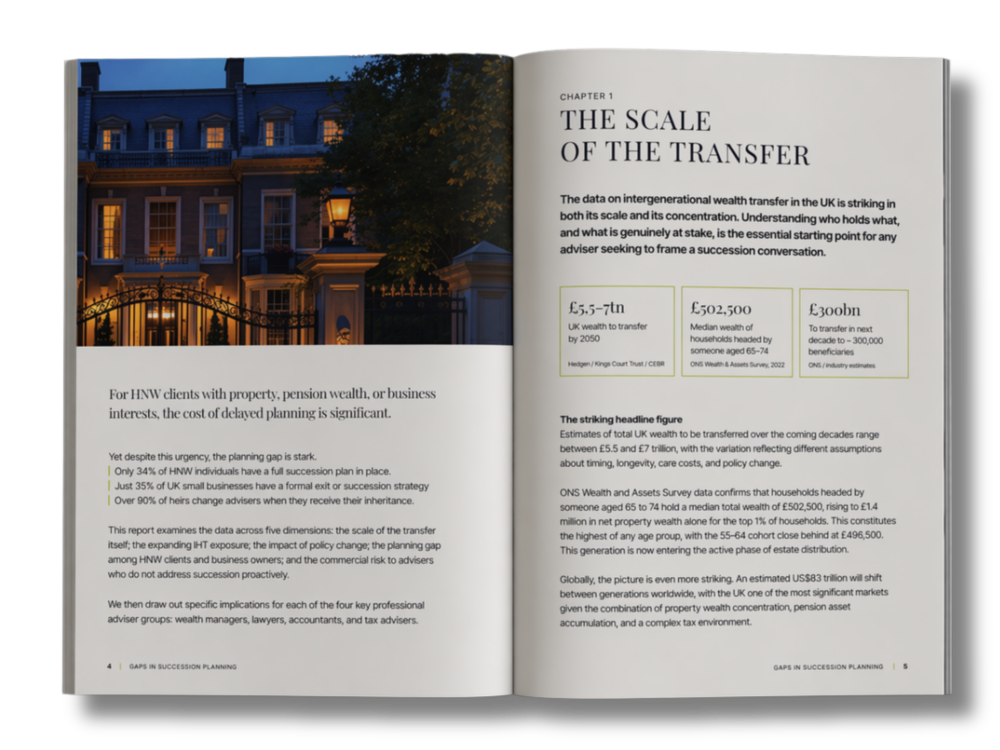
Why Inheritance Tax Mitigation & Succession Planning Have Become Urgent
- IHT receipts reached a record £8.2 billion in 2024/25, up 10.8% in a single year
- The nil-rate band has been frozen at £325,000 since 2009, confirmed frozen until 2030
- BPR was reformed in April 2026, capping 100% tax relief at £1 million of combined qualifying assets
- APR was also reformed, with 100% relief capped at £2.5 million of combined qualifying assets
- From April 2027, most unused pension funds will enter the inheritance tax calculation for the first time, affecting an estimated 38,500 estates
The OBR projects that by 2030, nearly one in ten deaths in the UK will result in an inheritance tax charge, roughly double the current proportion.
This report is intended for professional advisers only and does not constitute financial, legal, tax, lending, or protection advice. Henry Dannell recommends that individuals seek independent legal and tax advice in relation to their personal circumstances.

Ready to discuss a client's inheritance tax or succession planning position?
Whether you are reviewing an existing estate plan in light of the April 2026 BPR and APR reforms, preparing a client for the April 2027 pension changes, or looking for client-specific inheritance tax modelling as the next step towards finalising your estate planning, we would welcome the conversation.
This information is intended for professional advisers only and does not constitute financial, legal, tax, lending, or protection advice. Henry Dannell recommends that individuals seek independent legal and tax advice in relation to their personal circumstances.
Inheritance Tax Planning & Succession Planning: Your Questions Answered.
Inheritance tax planning is the process of structuring a client’s estate to reduce the inheritance tax liability that arises on death, or to ensure that the tax can be met without disrupting the assets beneficiaries are intended to receive. For a high net worth family where wealth is often held across property, pension funds, family businesses, investments, and trusts, the interaction between different asset classes and the applicable exemptions and reliefs can be complex. Effective tax planning ensures that the right structures are in place well before they are needed, and that the estate can be transferred to the next generation as tax-efficiently as possible.
Business property relief (BPR) is a tax relief that reduces the value of qualifying business assets for inheritance tax purposes. Historically available at 100%, BPR has been widely used by owners of family businesses, AIM-listed shareholdings, and trading companies to pass assets to a beneficiary free of inheritance tax on death. From April 2026, BPR has been capped at the first £1 million of combined qualifying assets, with 50% relief applying above that threshold. For business succession planning, this means that larger family businesses and investment portfolios that previously passed free of IHT will now carry a real inheritance tax liability and that funding or protection needs to be in place to meet it.
Agricultural property relief (APR) operates similarly to BPR, providing tax relief on the agricultural value of qualifying farmland and farm buildings for inheritance tax purposes. From April 2026, APR has been reformed with 100% relief capped at £2.5 million of combined qualifying assets. For farming families, this change significantly increases the potential IHT bill on the transfer of agricultural estates and makes succession planning, including the use of lending solutions to fund a tax liability without requiring a forced sale of farmland, a pressing priority.
Until April 2027, most unused pension funds sat outside the estate for inheritance tax purposes, making them a widely used vehicle for passing wealth to a beneficiary tax-efficiently on death. From April 2027, most unused pension funds and pension death benefits will be brought within the scope of inheritance tax for the first time. For clients with large, undrawn pension pots, this will create a new or materially increased inheritance tax liability, often at a combined effective tax rate of 64% or higher when income tax on the pension at the beneficiary’s marginal rate is also taken into account. Whole of life cover, written in trust, is one of the most efficient tools for funding this incremental IHT bill.
A family investment company (FIC) is a private limited company used by high net worth families as a vehicle for holding and managing investments and passing wealth to future generations in a tax-efficient manner. FICs can offer advantages in terms of income tax, capital gains tax, and corporation tax treatment compared to holding assets personally, and can be structured to give different family members different classes of shares, allowing control and income to be separated from capital value. For succession planning and inheritance tax planning purposes, an FIC can be an effective way of moving wealth out of a client’s estate gradually over time, though the tax implications of establishing and running one require careful legal advice and tax planning.
A will is the foundation of any estate plan. It sets out how assets are to be distributed on death, appointing executors, and making provision for a surviving spouse or other family members. Good legal advice ensures that a will is structured to make the most of available exemptions, including the nil-rate band, the residence nil-rate band, and the spousal exemption, and that it reflects any lifetime gifting strategy the client has in place. However, a well-drafted will is only the starting point. The financial solutions to fund any inheritance tax liability, support lifetime gifting, and ensure business succession arrangements can be executed must sit alongside the legal structure. This is where our role at Henry Dannell’s starts, we can recommend options and source the solutions.
A lifetime gift that is made more than seven years before death falls outside the estate for inheritance tax purposes entirely, with a taper of the potential tax relief applying in years three to seven. This makes lifetime gifting one of the most straightforward and effective inheritance tax mitigation tools available, particularly for clients who have sufficient income or liquid assets to fund gifts without compromising their own financial security. Where a client has illiquid wealth, for example in property, a family business, or an investment portfolio, a short-term lending facility can fund a significant lifetime gift immediately, starting the seven-year clock from the date the gift is made rather than the date the loan is repaid.
Please note: To understand the features and risks, always obtain a personalised illustration.